Cognitive empathy
Understanding feelings
“In that situation, you might feel anxious.”
Considering another person’s perspective and circumstances to understand how they feel, without necessarily sharing that emotion.

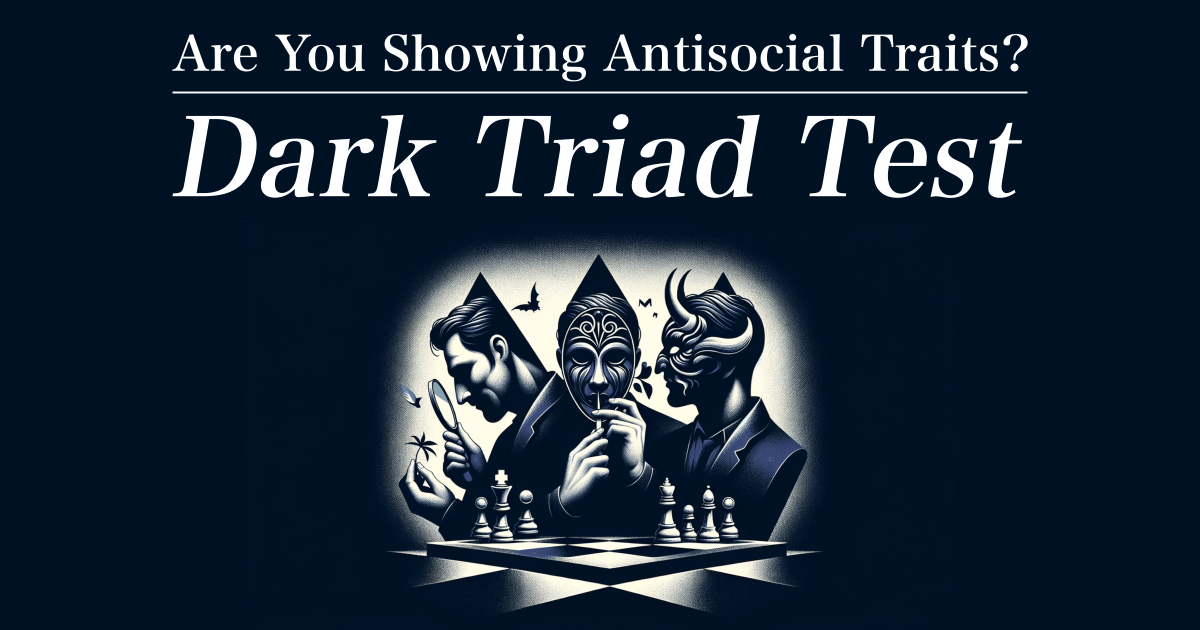
A dark empath combines empathy with antisocial traits, often using their ability to understand others' emotions for selfish or manipulative purposes. This test will determine your level of dark empathy in just 20 questions.
Noticing how someone feels and deciding how to respond are different things. Reflect on empathy and your approach to relationships through 20 questions.
Choose the answers closest to how you usually feel and act.
View your dark empath tendency as a percentage and one of five levels.
Explore relationship patterns, strengths and cautions, work examples, and suggestions for interacting with others.
This is a self-reflection tool, not a medical assessment or a career aptitude test.
A dark empath describes a combination of empathy and self-centred or manipulative personality traits. Understanding someone’s feelings does not necessarily mean acting in that person’s interests.
Heym and colleagues (2021) identified a group with both elevated empathy and dark triad traits. This research profile should be distinguished from the popular image of someone who can effortlessly read and manipulate minds.
Cognitive empathy
“In that situation, you might feel anxious.”
Considering another person’s perspective and circumstances to understand how they feel, without necessarily sharing that emotion.
Affective empathy
“Hearing your story makes me feel sad too.”
Experiencing an emotional response that echoes another person’s joy or sadness.
Empathy has multiple aspects. This test does not report separate scores for cognitive and affective empathy.
Recognising someone’s anxiety can lead to different responses. These examples illustrate the distinction; a single action is not enough to classify a person.
Listen, explain the options, and respect the decision they make.
Use anxiety or guilt to push them towards the choice you want.
The dark triad brings together the three traits below. The dark empath is studied as a combination of dark traits and empathy, rather than simply a fourth dark trait.
A strong sense of superiority or specialness, accompanied by a desire for admiration.
A strategic, manipulative approach to others that prioritises personal gain.
Traits associated with callousness, limited remorse, and impulsivity.
Empathy varies between people. Psychopathic traits do not imply a complete inability to understand others’ emotions. Describing personality traits is different from diagnosing a mental disorder.
These results describe the strength of a tendency within this test, rather than five separate personality types. The five result labels are shown below.
The explanation focuses on consideration for others and honesty.
The explanation describes empathy directed towards consideration for others.
The explanation explores the balance between empathy and personal interests.
The explanation discusses using emotional understanding for personal benefit.
The explanation focuses on empathy alongside manipulation and its effects on trust.
The percentage is a score on this test, not the probability that you are a dark empath or a population percentile. “Average Level” is also a label within this test.
A high score does not establish that someone is dangerous, and a low score does not prove that they are virtuous. Compare your answers with specific patterns in your own behaviour.
The research profiles are not equivalent to this website’s 20-question score. The cited paper does not validate the accuracy of this test.
The result includes strengths, challenges, and work examples. It does not separately measure abilities or career suitability. Your circumstances and self-perception can affect your answers.
Sources for understanding the research on dark empathy and empathy.
Heym et al. (2021), Personality and Individual Differences, 169, 110172.
Heym et al. (2019), Frontiers in Psychiatry.