Lawful Good
Values rules and justice while protecting others. Responsibility and honesty are strengths, though balancing consistency with flexibility can be a challenge.
Explore this type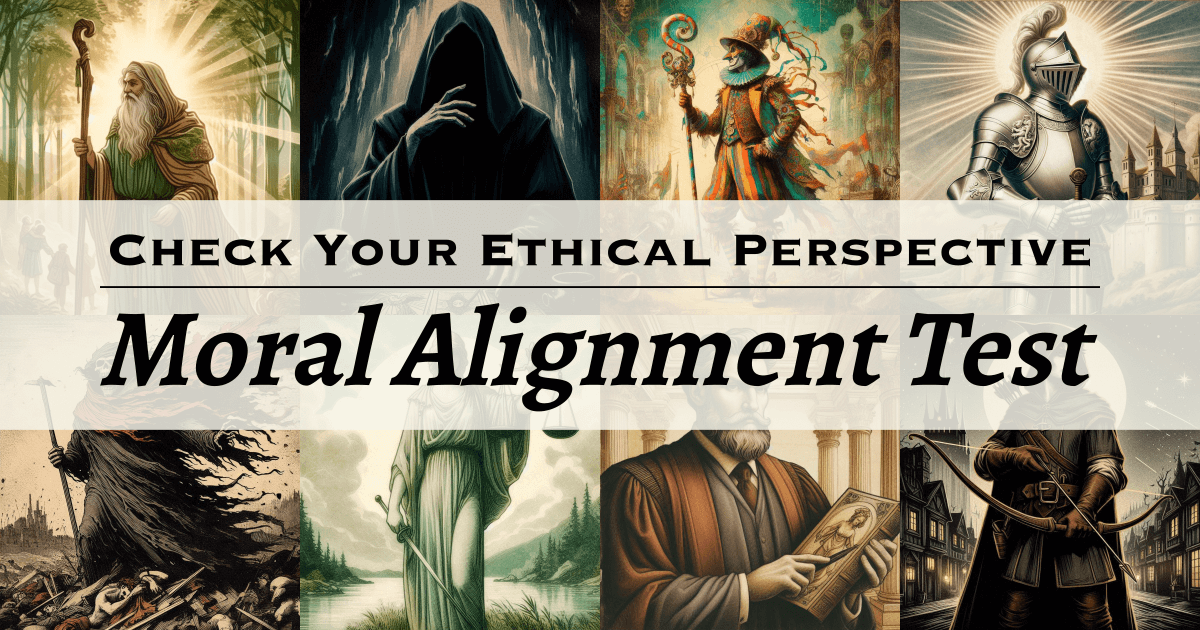
The Moral Alignment Test is designed to evaluate how moral you are. Inspired by the nine alignments from the game "Dungeons & Dragons," this test will help determine which of the nine moral types best describes you. Which alignment do you fall under?
Alignment describes a character’s values in the fantasy roleplaying game Dungeons & Dragons. This test uses 50 questions about rules, freedom, and relationships to introduce one of nine types that fits your pattern of answers.
Choose the responses closest to how you usually think and act.
See your pattern of answers expressed as one of nine alignments.
Reflect on what matters to you when making decisions.
This is a self-reflection test inspired by a game classification. It does not determine your moral worth. Compatibility and advice are general descriptions of each type.
Combine Good, Neutral, or Evil with Lawful, Neutral, or Chaotic to make a 3×3 grid of nine types. Neutrality is a position on each axis, not a third axis.
Lawful does not mean Good, and Chaotic does not mean Evil. Someone can help others by following rules or by challenging them. The two axes distinguish your aims from what guides your actions.
Even types that share a commitment to doing good can disagree about rules. Explore the three groups to see what each type prioritizes.
Values rules and justice while protecting others. Responsibility and honesty are strengths, though balancing consistency with flexibility can be a challenge.
Explore this type
Puts helping people first. Chooses what benefits others in the situation, without treating obedience to rules as the main goal.
Explore this type
Helps others while staying true to personal convictions and freedom. Challenges unfair rules, but may struggle to work in step with a group.
Explore this type
Prioritizes rules and responsibilities over personal feelings. Values consistent decisions and fair procedures, but may find it difficult to adapt.
Explore this type
Seeks balance rather than a firm commitment to good, evil, law, or chaos. Can assess situations calmly, though taking a clear position may be difficult.
Explore this type
Values independence and follows personal instincts. Thinks beyond established patterns, but moods and impulses can affect decisions.
Explore this type
Uses rules and institutions to gain power or personal advantage. Acts methodically, but may sacrifice others’ interests to achieve a goal.
Explore this type
Puts personal gain first and chooses whichever methods work. Has little commitment to either keeping or breaking rules, and may neglect others’ needs.
Explore this type
Puts personal desires ahead of rules and others’ rights. Strongly resists constraints, with impulsive or destructive behavior that can cause conflict.
Explore this typeColumns show attitudes toward law and chaos; rows show attitudes toward good and evil. Select a name to read the full description.
| Two axes | Lawful | Neutral | Chaotic |
|---|---|---|---|
| Good | Lawful Good | Neutral Good | Chaotic Good |
| Neutral | Lawful Neutral | True Neutral | Chaotic Neutral |
| Evil | Lawful Evil | Neutral Evil | Chaotic Evil |
In Neutral Good, Neutral describes a position between law and chaos. In Lawful Neutral, it describes a position between good and evil. True Neutral occupies the middle of both axes. No type should be used to judge a person from a single action.