Lion Chronotype: Strong in the Morning
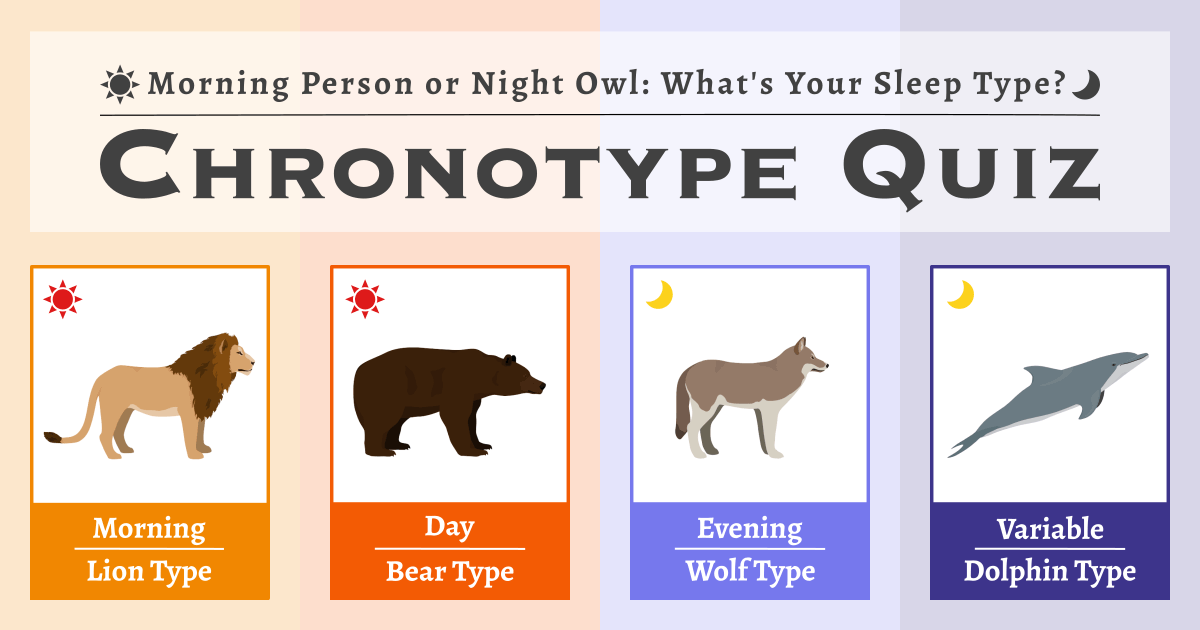
Chronotype Quiz - Morning Person or Night Owl: What's Your Sleep Type?
Do you know what kind of sleep suits you best? By understanding your chronotype, you can adopt a lifestyle that suits your genetic makeup. Which of the four animal chronotypes are you?
Available Languages



What Is a Chronotype?

A chronotype refers to your natural tendency for when you feel most alert and productive during the day. Some people are energized in the morning, while others focus better at night.
This isn’t just about habits or motivation—it’s influenced by your circadian rhythm, your body’s internal clock that regulates sleep and wake cycles.
Understanding your chronotype can help explain why mornings feel difficult, why you get a second wind at night, and when you’re most likely to feel tired or focused.
What This Quiz Reveals
This chronotype quiz analyzes your daily patterns and energy levels to determine which of the four types best matches your natural rhythm.
- Your chronotype type
- Your activity patterns throughout the day
- When you’re most focused and productive
- When you’re most likely to feel sleepy
- Your ideal daily schedule
- How your type compares to others
- Tips for work and study efficiency
- Ways to improve your sleep rhythm
The Four Chronotypes
This quiz categorizes chronotypes into four types: Lion, Bear, Wolf, and Dolphin.
These animal labels are used as simple metaphors to describe different daily energy patterns.
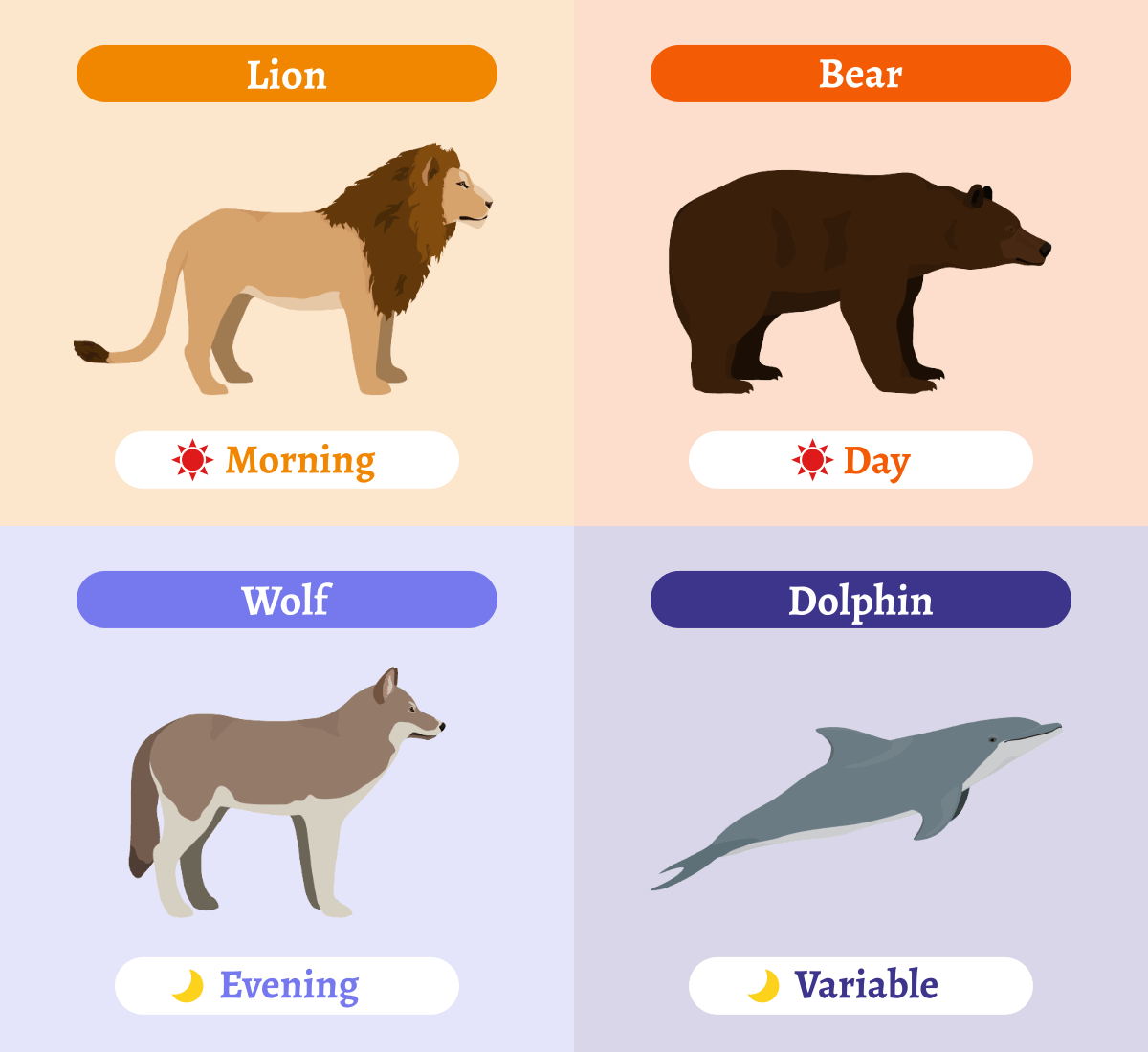
- Lion: Strong in the morning
- Bear: Active during the day
- Wolf: More active at night
- Dolphin: Light sleeper with irregular patterns
Characteristics of Each Type
Each chronotype has its own natural rhythm and optimal time of day for activity.
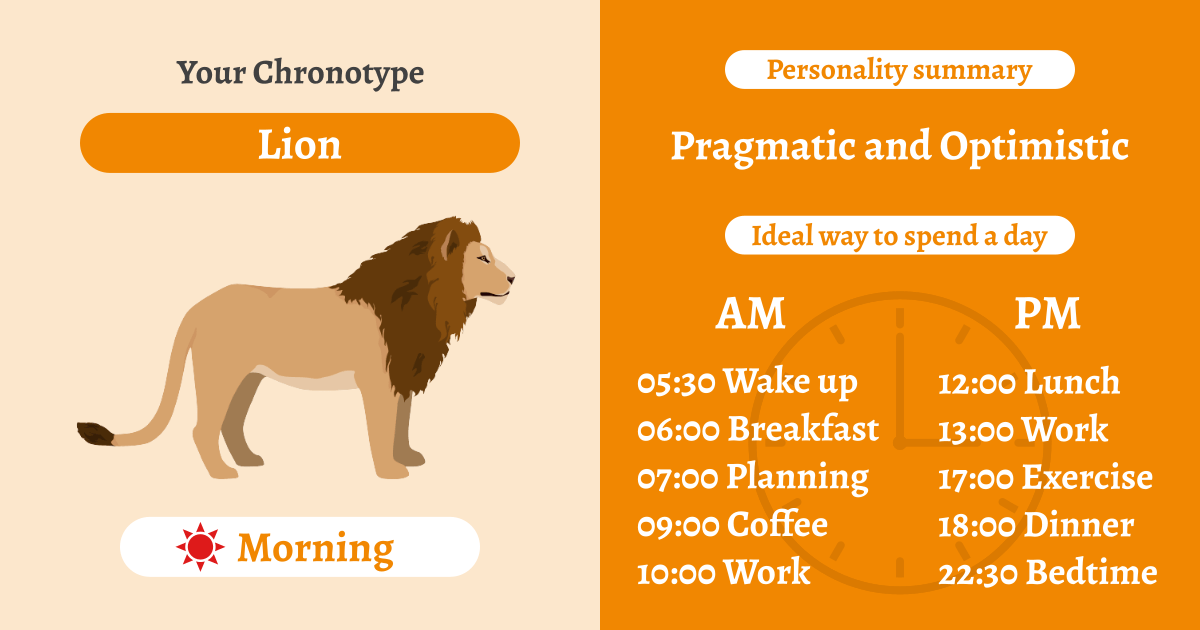
Lions are early risers who perform best in the morning. They’re most productive earlier in the day and tend to prefer structured routines.
Learn more about the Lion type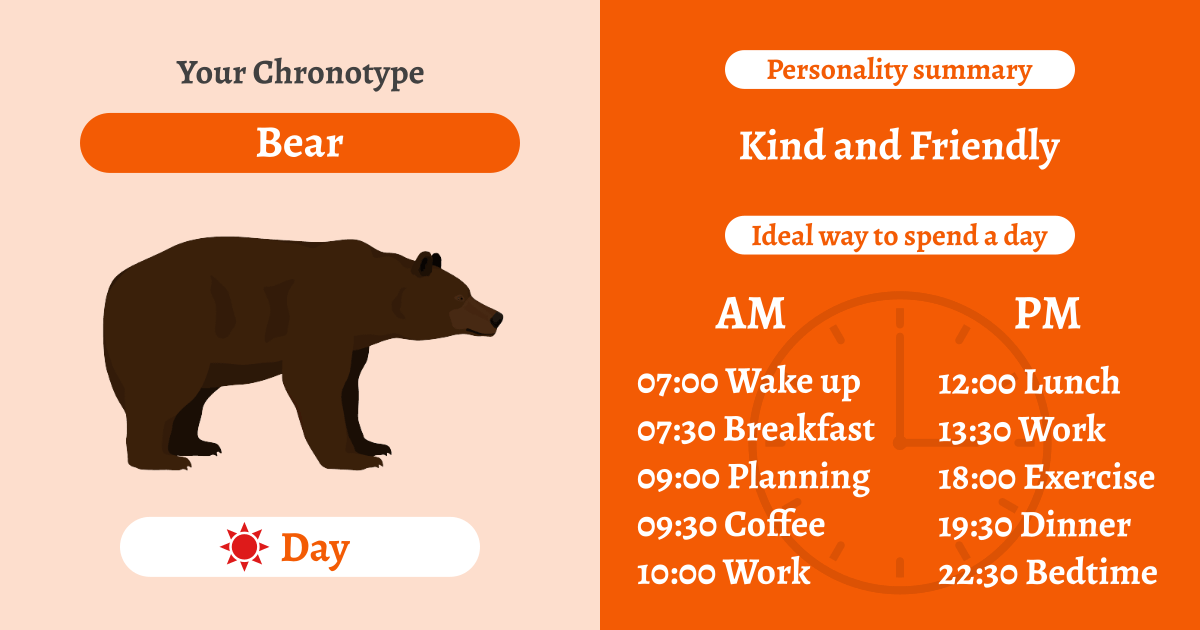
Bears follow a typical day-aligned schedule and feel most productive during standard daytime hours. They tend to have a balanced and steady rhythm.
Learn more about the Bear type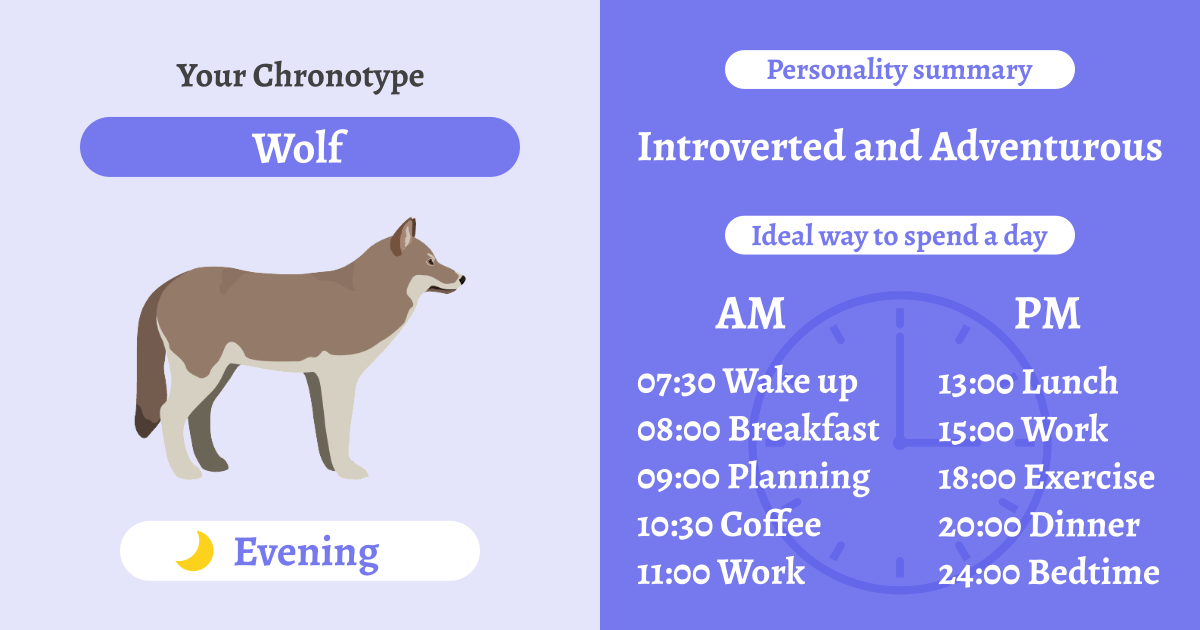
Wolves are night-oriented and become more alert as the day goes on. They often do their best creative work in the evening or late at night.
Learn more about the Wolf type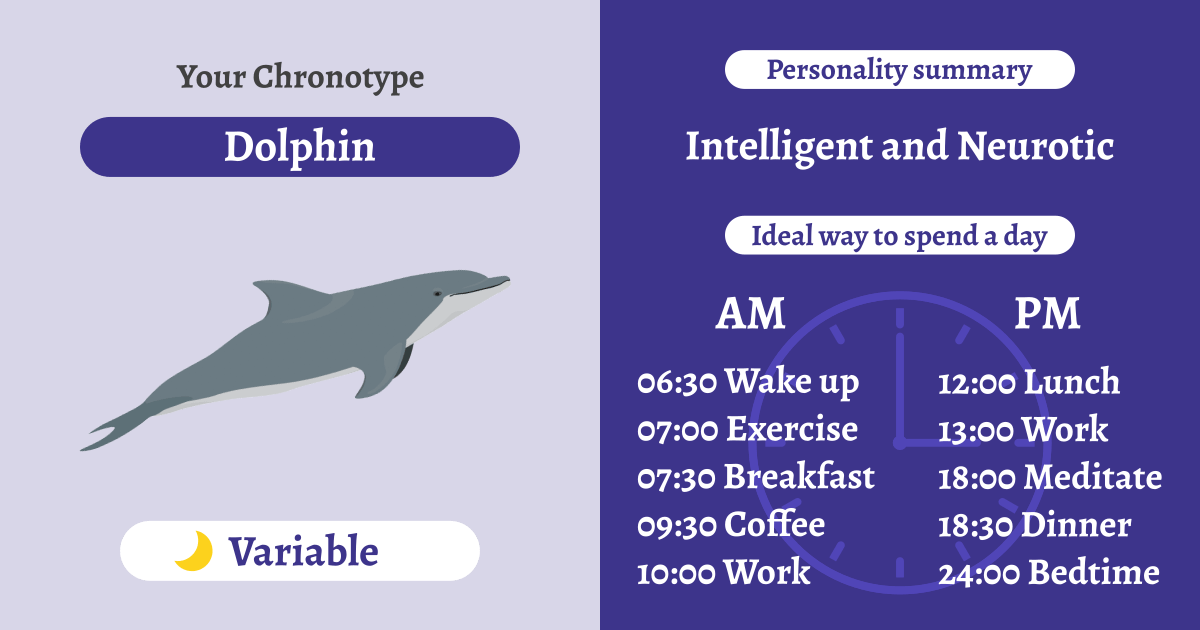
Dolphins tend to be light sleepers and may have irregular sleep patterns. With the right environment, they can still maintain stable performance.
Learn more about the Dolphin typeBenefits of Knowing Your Chronotype
Understanding your chronotype allows you to align your daily schedule with your natural energy levels instead of forcing an unnatural routine.
- Understand why mornings feel difficult
- Work during your peak focus hours
- Build a more efficient schedule
- Avoid forcing unrealistic lifestyle changes
- Predict when you’ll feel tired
- Improve your overall daily rhythm
What You’ll See in Your Results
After taking the quiz, you’ll get a detailed breakdown of your chronotype and how it affects your daily life.
- In-depth explanation of your type
- Distribution among other users
- Time-of-day performance patterns
- Recommended daily routines
- Strengths and potential challenges
- Comparison with other types
Before You Take the Quiz
This quiz is a general self-assessment based on daily patterns and sleep tendencies. It is not a medical diagnosis or a substitute for professional evaluation.
If you experience serious sleep issues or ongoing fatigue, consider consulting a healthcare professional.
Use your results as a helpful guide, not a definitive diagnosis.
Chronotype FAQ
Can your chronotype change?
A. It can shift slightly due to age, lifestyle, or schedule changes. However, your core tendency—morning or evening preference—usually remains fairly consistent.
Is being a night person bad?
A. Not at all. The key is understanding your natural rhythm and structuring your day in a way that works with it, not against it.
Should I try to become a morning person?
A. Not necessarily. While some schedule adjustments may be needed for work or school, forcing a complete shift can lead to stress and reduced performance.
Is chronotype the same as sleep duration?
A. No. Sleep duration refers to how long you sleep, while chronotype refers to when you naturally feel awake and alert.
Does being a Dolphin mean insomnia?
A. No. The Dolphin type simply describes a tendency toward lighter or more sensitive sleep, not a clinical sleep disorder.
Is this a medical diagnosis?
A. No. This is a general lifestyle assessment and not intended for medical diagnosis or treatment.
References
Chronotype Quiz
Morning Person or Night Owl: What's Your Sleep Type?
Take the TestMorning Person or Night Owl: What's Your Sleep Type?
A Complete Beginner Guide To Chronotype Quiz
Everyone discusses chronotype and how it may improve creativity, physical performance, and general happiness. This is true for teachers who study sleep and the owners of top startups. Here's a quick guide to figuring out your chronotype, how it affects your life, and how to use this powerful force to get more out of life.
What is Chronotype?
Everyone has a master biological clock in their brain, but it doesn't keep the same time or move at the same speed as everyone else's. This is because a study shows that different people work best at different times of the day.
For example, if you've ever heard someone say, "I'm a night owl," it's because some people work better at night than others. This difference is called a "chronotype" caused by a person's internal clock and circadian rhythms.
Chronotype is your circadian type, or how you are different in the morning and evening regarding how active and aware you are. A chronotype is a pattern of behavior that we develop based on our natural rhythms.
A person's chronotype is how they can sleep simultaneously every night for 24 hours. The key is for "each person to sleep at a certain time over 24 hours." So, why haven't they told you that you could sleep whenever you want in those 24 hours?
Learn Your Chronotype
First, let's figure out what kind of chronotype you are. Take the quiz below to find out what type you are and how to make the most of your time:
QUIZ
AutoMEQ is a quiz that tells you your chronotype and what to do about it.
The most study divides animal sleep into four main types:
- Bear
- Wolf
- Lion
- Dolphin
The Bear chronotype
People bearing chronotypes comprise about 50–55% of the population. This means that you sleep and wake up when the sun does. Do you see a change between 2 and 4? Bears usually sleep simultaneously every night but don't feel like they get enough sleep. If they stay up late on Sunday nights, they can't get into a routine during the week.
A Perfect plan for the Bear chronotype:
Bear chronotype morning schedule: 7 AM to 11 AM
- Get up and exercise for 8–10 minutes.
- If you eat a big breakfast and drink coffee, you won't eat too much in the evening, and the extra calories will give you the energy you need for the rest of the day.
- Plan your day.
Bear chronotype schedule production zone: 11 AM to 6 PM
- Start with the things that will take the most energy and focus. You'll be able to finish them faster and use your time better.
- Start your lunch at noon; it will give you vitality for the rest of the day.
- By lunchtime, you'll notice a decrease in energy levels. If you can go outside for a walk, sunlight and colors will help you wake up and fight off sleepiness. You could also take a short nap to recharge.
- You may start to feel tired again around 2 PM. Set up coffee breaks and meetings to help you get through the afternoon.
Bear chronotype's after-work schedule: 6 PM to 10 PM
- It's a great time to get a full workout in. Start with easier and lighter workouts, and keep the length to something you can handle, like a 15-minute HIIT exercise.
- After you work out, choose a light dinner with fewer carbs and more meat.
End of the day bear chronotype schedule: 10 PM to 11 PM.
- Bears can stay up late, which makes them grumpy the next day.
- So, you should turn off your electronics at 10 PM and go to bed at 11 PM.
The Wolf chronotype
Since wolves have trouble getting up early, they are often called "night owls." 15-20% of people put themselves in the "wolves" group. They hate getting up in the morning, going to bed too late, and setting their clock too often to sleep.
They usually work late and need 3 cups of strong coffee to get going. Wolves are more active when they wake up at noon because their most productive time is between noon and 4pm
Wolves also get a big boost in their output around 6 PM, so they can get a lot done when everyone else is done for the day. If you can set your work hours, that's great! But are you stuck forever if your job or shift requires you to stick to a daily schedule? Simply put, no.
A perfect plan for Wolf chronotypes:
Wolf chronotype morning schedule: 7:30 AM to 12 PM
- Set two alarms 20 minutes apart as a starting point. The first alarm is meant to wake you up, and the second is meant to get you out of bed.
- Come out to the porch or a window and sip some water while you take the view. It will help you stop being angry about everything.
- Walking or getting off at a stop that gives you 20–40 minutes to walk is best if you need to get to work. If you work from home, put on your shoes, put on some music, and go for a light jog or walk. A runner's high in the morning would wake you more than a cup of coffee.
- Have breakfast and a cup of coffee around 11 a.m.
Maximum productivity for the Wolf chronotype: 12 PM to 8 PM
- Important jobs should be put off until 1 p.m., and you should start slowly.
- At 2 p.m., you're at your most productive. Now, choose jobs that are hard and work on plans and strategies.
- You might still feel good at 5 p.m. Take a rest and then get back to operating. It's a great time to work on artistic projects and take a creative walk.
Wolf chronotype's after-work schedule: 8 PM to 10 PM
- Finish up your food around 8 p.m.
End of the day for wolf chronotype: 10 PM to 12 AM
- It's simple for you to stay up late, so set a note to make sure you turn off your devices and stop reading on your device by 11 PM. You should be asleep by midnight.
The Lion chronotype
The lion is different from the wolf in some ways. 15% of the people are "lions." They can get up a long time before sunrise and finish almost 80% of their jobs and chores before most people even get out of bed. But it's hard to keep up the same amount of energy in the afternoon and evening. They might look bored when they hang out with their friends at night. Usually, lions relax in the evening and sleep between 9 and 10 p.m.
A perfect plan for a Lion chronotype would be:
Lion's morning schedule: 5:30 a.m. to 10 a.m.
- It would help if you had fewer carbs and more meat for breakfast.
- You can either relax or work out after breakfast before the rest of the world gets up.
- Almost 10 AM, I have a coffee.
Maximum productivity for Lion chronotype: 10 AM to 5 PM
- Since you ate breakfast 3–4 hours ago, you could take a short break and eat a protein bar, yogurt, or cottage cheese.
- You have the most energy, so do as much as you can.
- Don't plan meetings in the evening, because you'll be too tired or bored to pay attention. Instead, put them on your calendar for the afternoon.
- You still have enough energy after lunch to stay for another two hours. After that, choose easier jobs to do.
Lion's after-work schedule: 5 to 9 p.m.
- Around 5 p.m., when you've been awake for about 12 hours, you may feel tired and avoid jobs.
- If you can, take a short nap.
- You can also work out to give yourself more energy.
- As early as you can, eat a healthy dinner.
End of the day for the lion chronotype: 9 PM to 10:30 PM
- You have the energy to hang out with friends or watch that show on Netflix because you worked out and ate well.
- But it would help if you went to bed at 10.
The Dolphin chronotype
You might be a dolphin if you've ever had trouble sticking to a sleep routine. Dolphins make up almost 10% of the world's population. These people have trouble falling asleep, staying asleep, and spending their nights looking through feeds and browsing without a plan. Still, between 10 AM and 2 PM is an excellent time to get things done.
A perfect plan for a Dolphin chronotype would be:
Morning dolphin chronotype schedule: 6 AM to 10 AM
- A run or light exercise is the best way to start the day.
- Take a cold shower if it's hot where you live.
- Have an even amount of carbs and protein in your breakfast around 8 a.m.
Maximum production for the Dolphin chronotype: 10 a.m. to 6 p.m.
- Remember how caffeine affects your blood sugar level, and drink small amounts of coffee.
- Between 10 AM and 12 PM, you have the most energy. This is the best time to choose the hardest things on your list and get them done.
- Around noon, you may start to feel tired. At that point, you should get up and go for a 20-minute walk.
- You'll have enough time to finish your work by 6 o'clock.
Dolphin's after-work schedule: 6 PM to 10 PM
- Choose a small lunch like a banana, a protein bar, or a salad, and then go to the gym or do a workout at home. Don't do power workouts because they won't help you sleep well.
- Finish eating by 9 o'clock. It's a good time to spend time with friends and family or solve hard problems.
End of the day for the dolphin chronotype: 10 PM to 12 AM
- Take a nice, warm bath, turn off all your devices, and smuggle a book into bed.
- Go to bed by noon. You may not fall asleep immediately, but find the position that makes you feel most comfortable.
Conclusion
Knowing your chronotype and how it affects your sleep, you can work with your body to use your time best. This can help you be more productive, get ideas going, and improve your health.