Extraverted Sensing (Se)
Notices what is happening here and now through direct sensory experience.
An everyday perspective
I want to see it and try it myself.
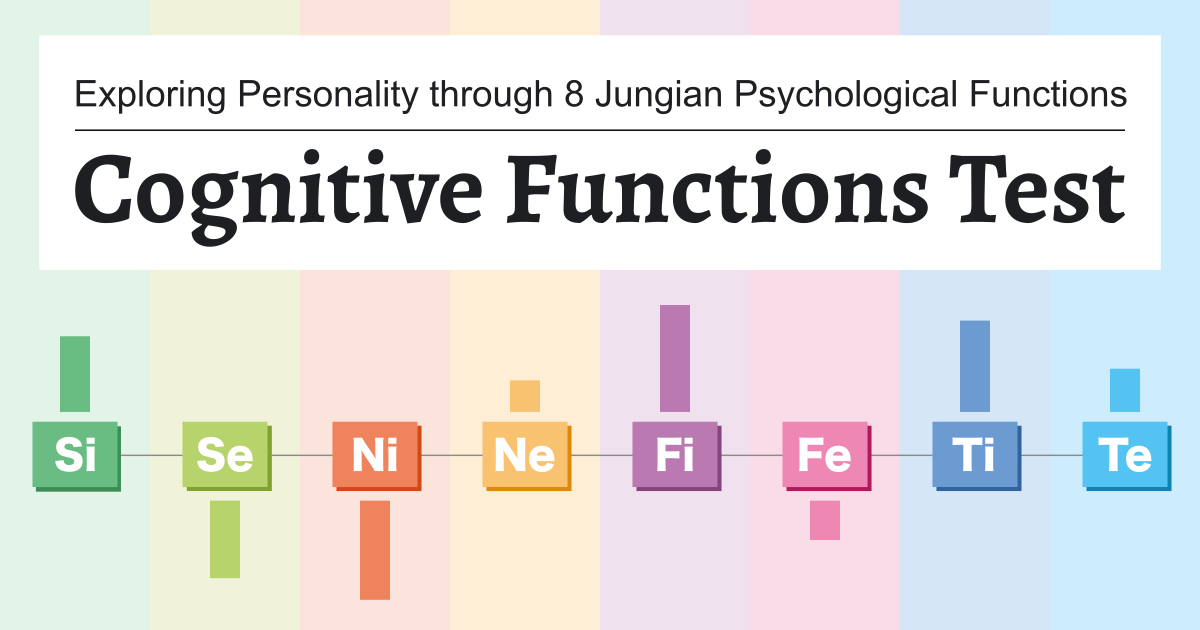
Cognitive functions, introduced by psychologist Carl Jung, help explain the structure of the human psyche. This test provides scores for all 8 cognitive functions, offering a comprehensive analysis of your psychological makeup. Answer 60 questions to gain a complete overview of your cognitive function scores.
People notice different information and use different criteria when making decisions. This test organizes your answers about everyday thoughts and behavior into scores for eight cognitive functions.
Answer about everyday life
Scores reflect your answers. Strengths and challenges are general descriptions of each function, not an individual assessment of ability or career suitability.
Based on Jung’s theory of psychological types, cognitive functions describe ways of taking in information and making judgments. Four basic functions combine with two orientations, extraverted and introverted.
Attending to concrete facts and experience
Attending to connections and possibilities
Considering logic and consistency
Considering values and effects on people
Attention turns toward external events, people and situations.
Attention turns toward inner impressions, ideas and values.
4 functions × 2 orientations = 8 cognitive functions
Extraverted and introverted do not simply mean outgoing and shy. Feeling does not mean emotional intensity, and Thinking does not mean greater intelligence.
These are not eight exclusive categories of people. Explore the focus of each function, then compare the descriptions with your own results.
Notices what is happening here and now through direct sensory experience.
I want to see it and try it myself.

Relates current experience to remembered impressions and past experience.
How does this compare with what I tried before?

Spots new connections and alternative uses to explore more possibilities.
Where else could this idea work?

Forms inward insights to explore underlying meaning and direction.
Where might these events be leading?

Organizes decisions around external criteria and outcomes to work toward a goal.
What should we do first to reach the goal?

Looks closely at how things work by refining principles and checking internal consistency.
Is there a contradiction in that explanation?

Considers people’s feelings and shared values to seek mutual understanding.
How can I explain this in a way everyone can accept?

Looks inward at personal convictions and judges in relation to deeply held values.
What matters too much to me to compromise?
Your results show a number and a chart for each function. Differences reflect the tendencies expressed in your answers to this test.
A negative bar falls below the chart’s reference point. It does not indicate a defect or abnormality. These values are not population averages or percentile ranks.
A higher score means that the relevant characteristics appeared more strongly in your answers. A lower score does not mean you cannot use that function.
Compare the functions and consider situations that fit their descriptions. A small score difference need not imply a major personality difference.
Recent experiences and how you see yourself can affect your answers. Treat the scores as prompts for reflection rather than proof of a fixed personality.
You may also encounter the terms dominant, auxiliary, tertiary and inferior. Within type theory, they describe functions’ roles and relationships.
Sorting this test’s scores does not establish that order or determine a four-letter type. The word inferior does not refer to a person’s worth.