Your highest-scoring type
See the area with your highest score and an introduction to its characteristics.
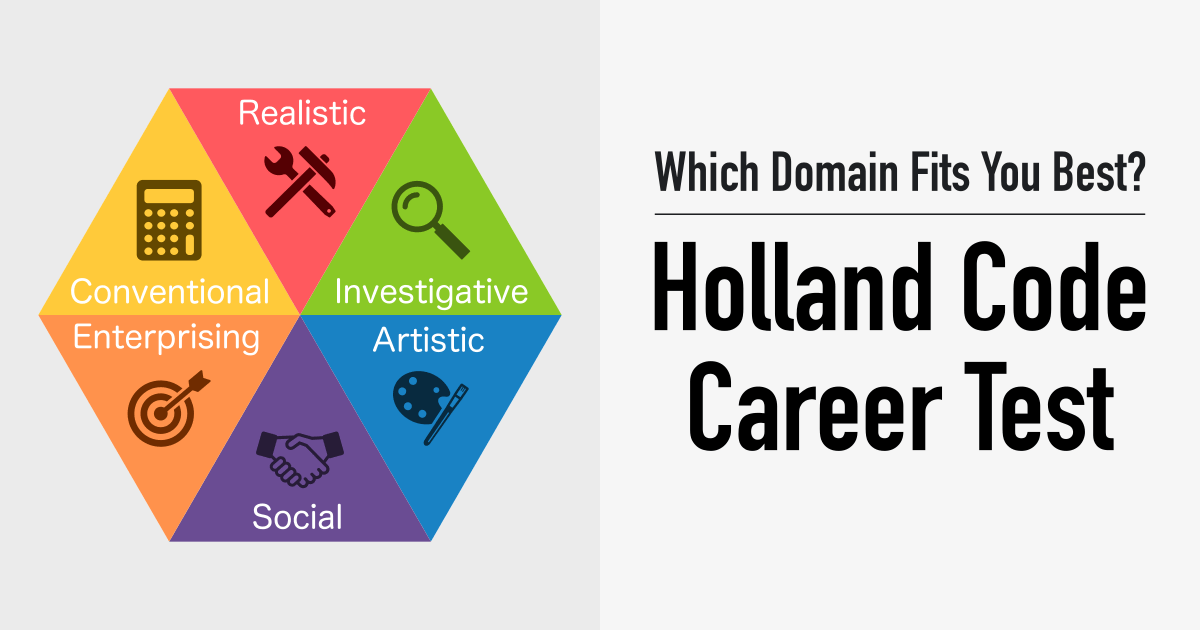
The Holland's Theory of Career Choice categorizes suitable careers into six types based on your interests and abilities. By taking this test, you can find out which career fields are a good fit for you. What kind of job matches your strengths? Discover it now!
Developed by psychologist John Holland, this theory describes people and work environments through six types. It offers a starting point for career exploration by asking what activities you enjoy and what kinds of work draw your interest.
The initials of the six types spell RIASEC. Your interests can span several areas, so their combination matters as much as any single type.
Answer about your everyday self
Compare six area scores
Explore ideas for your career
See the area with your highest score and an introduction to its characteristics.
Six scores and area-by-area explanations help you compare your interests and self-perceptions.
Job examples reflect the tendencies described for each area. Use them as starting points for exploring the work involved.
This is Hitostat’s own test based on 50 self-report questions. It is not a practical ability test or an official O*NET assessment.
Think about the activities that naturally catch your attention. Each type describes a different focus, with its own contribution to work.

An interest in building, fixing, and making things work. Using tools, machines, or physical materials to produce tangible results can be especially appealing.
Making things, repairs, outdoor work

An interest in exploring questions and explaining how things work. Observation, research, and analysis offer ways to examine evidence and understand why something happens.
Experiments, research, data analysis

An interest in creating and expressing original ideas. Open-ended activities offer room to experiment, use your imagination, and bring an individual perspective to life.
Design, writing, music and art

An interest in helping people learn and grow. Teaching, listening, and supporting others can feel meaningful when they improve someone’s understanding or well-being.
Teaching, listening, supporting people

An interest in bringing people together to achieve a goal. Making proposals, negotiating, and leading others can turn shared plans into action.
Planning initiatives, negotiating, leading teams

An interest in organizing information and keeping work on track. Working accurately with records, numbers, and clear procedures helps activities run smoothly.
Record keeping, calculations, data management
The hexagon places R, I, A, S, E, and C in sequence to illustrate similarities between interests. Neighboring types share more features; opposite types tend to emphasize different activities.
R and I, for example, share an interest in things and how they work. Building something and investigating its mechanisms can overlap.
R and S emphasize different activities, such as working with things and helping people. You can still be interested in both, even though they sit apart.
This is not a chart of interpersonal compatibility or better and worse types. The letters match the type descriptions above.
A Holland code represents interest areas with letters. It commonly lists the three strongest areas in order, capturing a combination that a single type cannot fully describe.
Example: investigate → create → help people
I, A, and S bring together interests in inquiry, creative expression, and helping others. This illustrates how to read a code; it is not your result.
This test displays your highest-scoring type and scores for all six areas. It does not automatically assign a three-letter code.
Consider your other high-scoring areas as well as the first one. When scores are close, exploring the activities they share can be more useful than focusing on their exact order.
Daily activities vary by role and workplace, even within the same occupation. Pick a job example that interests you, then investigate its tasks, training, and qualification requirements.
Enjoying an activity and already being good at it are different things. A low score or an “unsuitable” label should not close off a possibility. Consider your experience, skills, values, and practical needs too.
National Center for O*NET Development
U.S. Department of Labor, 2021
These sources explain the theory and career interests. They do not establish the accuracy or validity of Hitostat’s questions or scoring.